Does art imitate life, or does life imitate art? An oft asked question, but the apparent assumption is surely wrong - that one might be true does not mean the other must be false. Why did I even ask the question?
Yep - I'm once again lost in the pages of an interesting book, one that began simply enough but soon began to reveal layers of interwoven complexity that had me questioning my own perceptions - not only of the words I was reading, but of memory, understanding, and my experiences with life and other people.
My encounter with The Menagerie of False Truths developed from a simple beginning that soon took on twists and turns that echo its contents. Awake before dawn, and not wanting to disturb a sleeping household, I often put earplugs in and turn on my tiny pocket radio. At 5 am on most Saturdays of the year, the ABC Sydney station, as well as the one on the Central Coast, broadcast a show called The Big Fish.
The name, and even the promotional material, imply a show that might largely be a one hour fishing report from various correspondents around New South Wales, when in fact it is a radio stage, across which parade a remarkable array of characters, who tell fascinating, informative, and (mostly) amusing stories about people, fish, nature, weather, and, sometimes, politics.
This particular morning I tuned in a bit late, and found myself listening to the host, Scott Levi, questioning a chap about some exotic location in which he had been fishing for trout. The speaker, eventually identified as Greg French, was articulate and erudite, and it became apparent that he had written a number of books. A casual angler myself, I had not previously encountered his work - audio or published - and made a mental note to check the catalogue of my local library to see if we held anything by him.
We did, though we are not yet in possession of his latest book - Water Colour - but held other items by him, including "Menagerie" It was a title strange enough to pique my curiosity, and I ordered it sent up from the branch at which it had been reposing.
It swirls, as the pages turn, from disturbing, to amusing, to tragic, and back to disturbing, all the while informing as well as questioning. French touches on - digs into - aspects of perception and mis-perception, understanding and mis-understanding, ability and its lack, art, life, arrogance, humility, love, anger, grief, and suffering.
Each new understanding, though, came with an awareness that there must have been much more that I had missed - a re-reading will be in order, along with diversions to investigate concepts and information previously unmet.
At the heart of this novel are the perceptions, understandings, and behaviour that arise from the differences of mind and thought that society refers to as Autism, or The Spectrum, and the effects that those differences send to ripple out through families and communities that surround such people. It can be too easy to forget that each of us has a particular way of perceiving and understanding the world around us, and that of course affects our responses to the world and the life in it, including other people - what we see and hear may well be quite different to what they see and hear and feel.
Like fingerprints, each world view has its own unique whorls and curls and patterns - fingerprints, like world views, are meant to help us get a grip on the world around us; each pattern, though unique, still does its job, though some do not fit their surroundings as well as others.
The world we live in is complex, from micro to macro, beyond our ability to fully understand - but understanding it is a journey worth taking. Surprises are guaranteed, but so is delight.
Showing posts with label points of view. Show all posts
Showing posts with label points of view. Show all posts
Monday, 3 September 2018

Monday, 19 February 2018
What Do You Know?
Write What You Know - that is one of the more commonly proffered pieces of writing advice that would-be authors encounter. What does it mean? Is it the truly profound advice that some claim it to be? Is it a trite aphorism tossed off to hold more difficult questions at bay?
What do you "know"? What is that I "know" that I can write about? For those aspiring writers who feel, as so many people do, that the story of their own life is too ordinary to be worth writing about or from, that advice can feel like a door slamming in their face. Many people take it to mean that they should be writing about the experiences of their own life; they look at the amazing stories already on the bookshelves and think "I can't compare to that"
The chances of that thought being correct are actually miniscule - you have lived, and loved, and feared, and had moments of courage and ecstasy - the thread of your life is woven with the lives of you friends, family, colleagues, teachers, schoolmates, and neighbours, into the larger tapestry of life. Think "Six Degrees of Separation" - it is likely that you have had a unique view of events and places and people that others would like to hear about, but you have failed to realize it because it seemed somehow commonplace or ordinary to you.
You may not know what you "know" but there are ways to discover that "knowing" - an exercise that I found interesting might also work for you.
While trying to recall the name of someone I had known in a rural valley in which I had lived for a couple of decades or so, I realised that there were other names I had forgotten. It was distressing - that community had been a big part of my life for a long time, and though I left there eighteen years ago, I felt I should still be able to remember those people.
So I started writing down the names of those I did recall, expecting, perhaps, to fill a foolscap page, but each easily recalled name evoked memories of incidents and occasions, which called up the names of others who had been in that particular story but whose names had, until then, escaped me.
Those names had their own stories and memories, and the list grew, spreading onto the next page, and another, and another. Before long, a threadbare list had begun to grow into a rich tapestry of memory - and I realised that a couple of hours had flown by, and there was still more to write down.
Events and people I had quite forgotten turned out to be patiently waiting for their moment to rise to the surface, and thus remind me of other events and people who had faded into the mists of time. Try it - you might find the results quite interesting, and find all sorts of stories worth writing. Even if you feel the real facts do not contain the makings of a famous biography, they might easily be embroidered into an interesting piece of fiction.
Another way to broaden your understanding of your own "knowing" is to listen to podcasts like the ones from Richard Fidler, on the ABC. He and Sarah Kanowski present, each week-day, an interview with someone whose life has been deemed by others to be "interesting". Many of those interviewees do not see their own life as interesting - but they are. Some are quite amazing, and many will contain commonalities and congruences with your own life and the lives of your family and others you know. They will give you a better sense of where your thread fits into the tapestry of human life, and where it might yet go.
Another source of encouragement and knowing can be in reading the history of particular periods in which you, your parents, or grandparents, have lived. Again it is possible to discover that you were on the fringe of great events, and saw things that could add to the larger story if you were to write about them. I have been reading a book called Radical Sydney and it is quite an eye-opener.
Covering many crucial moments in Australian history, and relating them to specific locations within Sydney, it brings back to the surface many stories that officialdom would sooner we forget. Some of those stories were about moments that I had been on the fringe of, or, sometimes, involved in, and showed me aspects that had not been visible from my viewpoint. The seventies and eighties in Sydney were often lively times, populated by some wild characters - good and bad - and what made it into the papers or onto the evening TV screens was never the whole story.
Perhaps you are far to young to have experienced those times - but it is likely that you know people (parents, grandparents, aunts or uncles) who did experience it. Have a look at the list of people you have been making - what do you know about them? What do they know, and might they still be waiting for someone to listen to their story, to write it down and offer it to the world? Think about your own times - you have a role in what is happening now, a point of view worth hearing about, and even if you don't think so now, down the track there will be questions asked that you might already have answered.
Stand back and look at your own life - it will be more interesting than you realised, and will be inter-linked with many other interesting lives, events, and places. All you need to do is stand back far enough to be able to get a proper look at it and you will discover that your "knowing" is far greater than you realised. Take out your pen - once the ink starts to flow onto the page, the memories and ideas will follow.
Sunday, 4 February 2018
Knowing your world
It is said that many hunter-gatherer peoples offered thanks to the spirits of the animals and plants that they took for food, giving gratitude and respect for the gift of life. And straight away, I must digress - I used that term "hunter-gatherer" because it is what I learned in school, over 50 years ago, and yet books like Dark Emu, by Dr. Bruce Pascoe, show just how intensively and intentionally those supposed "gatherers" intervened to increase the productivity of their territory. Back to the story.
At some point in human history, before cities formed and empires grew, deities were named and thanked as being the directors or providers of weather, fertility, and food. Stories of creation were told, genealogies handed down, and sagas and epics were chanted to remind us of the deeds and misdeeds of our ancestors and their enemies. People could identify a story within which they lived, and picture their own place in it, as well as locating all the life and landscape around them.

The cities appeared, and kings, and emperors, who took to themselves the title of divine, and exercised control - they claimed - over all the resources the people needed. As king fought king, and empires rose and fell, many people sheltered in the cities, while beyond the walls, the slaves and peasants continued to fish, farm, and hunt.
Is that when humans began to look less closely at, as well as appreciate less, the plants, animals, and things that we use for nourishment, medicine, comfort, and clothing? When their gratitude shifted to the kings and emperors?
Those hunter-gatherers were living in, and respecting, the world that gave them being, nurtured them, and took them at their end - sometimes even brought about their end. Their civilized cousins had walled themselves in, putting the natural world at a greater distance, though the enemy that had inspired the wall was actually other people.
We live in that same world - it is still the source of all, excepting sunlight, that we need for life and comfort. In the case of sunlight, the atmosphere that filters that light, and protects us from its excesses, exists only because of life.
Yet every year it seems that more and more humans reach adulthood with no real knowledge or understanding of the world we rely on. How can we have respect for our home if we do not understand it?
Baba Dioum wrote: "In the end, we will conserve only what we love, we will love only what we understand, and we will understand only what we are taught"

The world we live in is complex beyond our ability to fully understand. Our brains, facing a flood of data, have developed mechanisms to filter and sort through all that information. We seek patterns in the data, and try to develop a sense of cause and effect for every thing we see, hear, feel, taste, and sense. We seek a sense of certainty and safety, and tailor our stories accordingly.
Yet, when we have made for ourselves a story that is comforting in its certainties, we have placed ourselves at risk of real harm. We know our world only partially - it is rare that we can be absolutely certain of our future, even that which is only seconds away. As for next week, month, or year, certainty is a dangerous illusion.
A story that takes into account such uncertainty, and helps us reach for the skills and resilience we might use when the unexpected arrives, is a better story - and, who knows, the unexpected might be more wonderful than we have imagined?
A comfortable story is a risky story because it can lead us into a sense of false security, so that we do not pay such careful attention to the world around us - its inhabitants and their behaviour. It is when you stop paying attention that the nasty surprises can sneak up on you, and the serendipitous opportunities slip by unnoticed. But attentiveness and alertness use energy, and we humans have another useful habit - we like to conserve energy. Some might call it laziness, some might call it sensible, but our ancestors learned not to burn energy unnecessarily, especially when their next meal might not eventuate as soon as hoped for. Like all human traits, it has its up sides and its down sides.
To survive and flourish, we need a story that makes sense of the world we live in, and gives us purpose, hope, and direction. With the aid of our ancestors, we learn and develop a story by which we live. Each of us has our own unique story - though it may contain many elements in common with the stories of those around us, it also is built from moments of personal experience and thought that no one else can fully share.
Our story is also influenced by the stories we hear and see - and many of the stories we encounter in the media or online are not honest tales. In many cases they are created, constructed, designed, and polished so as to distort our personal story in ways that benefit the makers of those stories. Yes, you can think "advertisers" or "politicians" when you read those words, and you would be partly right, but there are others creating and foisting dodgy stories on the world, and doing so for reasons not always explicable or reputable.
Many of the stories that wash over us every day have very narrow interests at their heart, and if we are to create an honest and useful story for our own life we need to be able to discern which of those stories should be discarded, and which ones kept. To do that, I think we need to spend time with other people that is not filtered or mediated by technology, and when we have had our fill of people, we need time in nature - real nature, not pictures and sounds on the screen or page.
Real people and real nature enter our story by way of all our senses, not just the visual and auditory - perhaps that is why the poetry and writing that most moves us contains cues for all our senses, too.
Thursday, 30 November 2017
The Mists of Memory
How's your memory? Cluttered? Neatly organised and cross-referenced? More or less absent?
Do you know how your memory works? Are you one of those people who digs and searches in vain, only to have the answer appear sometime during the early hours of the next morning? Or, are you one of those who have constructed an elaborate "palace of memory" that allows you to locate and examine a vast array of carefully stored facts and figures?
How do they do it? My grandmother seemed able, whenever recounting even the most minor of incidents, and without losing the thread of the story, to digress into the relationships, address, employment status, character flaws, and personal life of each new character as they entered the story - taking twenty minutes to relate an event that my grandfather would have told in two.
My mother in law has a similar skill, and is able to apply it to stories dating back almost eight decades. My father had a phenomenal memory for names and faces, and the histories, addresses, and vehicles associated therewith - a handy skill in his case, as he spent decades as a police detective. It was nothing for him to recite from memory - accurately - the contents of a thirty page statement of evidence.
I have several friends who have the ability to remember not only the names of everyone in their extended families, but most or all of the people with whom they worked, or went to school, church, and university with. If that were not bad enough, they also seem able to remember their birthdays and marital status, as well as the names and birthdays of their children and grandchildren, and the birthdays of all the spouses of the people they know.
I have enough trouble remembering the names of all the grandkids in my family, let alone their birthdays, and as for the spouses or partners of children and step-children and siblings, well, for that I would need to do some sort of undergraduate course. There are other things - facts, figures, events, scientific equations, and all sorts of interesting incidents of both dramatic and humorous nature - that have stuck; don't ask me why, I really don't know.
Moments of great embarrassment dating back to my first decade of life seem to have clung to existence in my memory banks, no matter how much I wish they would just fade away. And, of course, the moments of crisis - fire, flood, disaster - all lurk to trip me up at unexpected moments.
And yet, on one occasion recently, I decided to draw up a list of people I had known when I lived in The Valley (as its residents call it) during a period between forty and twenty years ago. I had been thinking about doing a small essay on an aspect of the history of the place, but could only recall a few faces, and fewer names.
Once I began typing, each name called up others that would otherwise have escaped memory, and before I knew it, ten pages of two line entries - a name, and the reason I knew them - had been filled. Many of those names were ones I would not have been able to reach directly, if someone had asked me "Who was that person that........?" but associations helped build a web of relationships and stories. Memory - truly strange.
Remembering and forgetting are such crucial aspects of not only our daily lives, but of our development from childhood, onwards, and of vital importance to our education system, medical science, and politics, and yet we do not have anywhere near a complete understanding as to how memories are formed, stored, and retrieved. As a field of science, memory is one of constant conflict and debate, as is the field of consciousness, with which is it is so closely intertwined.
We do know that there are all sorts of triggers that can invoke memory at unexpected moments - scents, sights, sounds, music, emotions - and those invocations can be wonderful, or poignant, or traumatic.
As writers, we rely on our memory to hand us a flow of interesting words, facts, scenarios, and emotions that we can use to create our stories. It's a wonderful feeling when the pen is gliding across the page, racing to keep up with the flow of interesting words that have bubbled up to the level of consciousness. One idea leads on to the next, and another, and before you know it, a story has spread from the top of the first page to halfway down the twentieth. People, places and incidents you might otherwise have struggled to recall have galloped back into view, vying for a place - even if disguised - in your latest literary effort.
And then there are your characters - what sort of memory do they have? Sharp and detailed? Fading? Or even that sad patchiness of recall that can come with the onset of dementia? Is their memory accurate? Are they telling the reader, or the detective, or their spouse, or their children, the truth? Do they believe it to be the truth, or do they understand that they are playing someone false? Have they even created false memories for themselves, in denial of painful reality? How does their memory compare to that of the other characters, or to the facts known to the omniscient narrator? Such disparities can trip a writer very badly, or be intentionally used to keep the reader guessing right up to a final, satisfying ending.
In short - no matter how good you think your memory is or isn't, and no matter how low an opinion you may have of your writing skills, it is all in there, somewhere, waiting for the opportunity to dance across the stage of memory or the page of creativity. It will have that opportunity if you only start writing or typing. Go for it - you will surprise yourself.
Tuesday, 24 October 2017
The Graduate
Recently I watched The Graduate (Dustin Hofman, Anne Bancroft - music by Simon and Garfunkel) - made in 1967, the year of The Summer of Love. The USofA and the world in general was in the throes of great social change. The waves made during that summer spread through society - its morals, work, culture, and politics. The Graduate seemed to be meant to reflect the cultural clash between the generation that had survived World War Two, and their children.
At the time it was promoted as both a drama and a comedy - now, at times, in modern eyes, it seems quite creepy, and I struggled to find any humour in it at all. Almost everyone in the movie is trying to impose their will on someone else. Hofman's character seemed very wooden by any modern standard of acting - was that meant to depict some internal emotional turmoil, or perhaps an attempt to show a character we would now describe as "On the Spectrum"?
His treatment of the ultimate target of his affections - Elaine, the daughter of his lover - can only be described as stalking, and the denoument at the wedding looks more like an abduction than a mutual flight into a romantic future. Although Elaine finally reacts against the demands of her parents and older relatives by fleeing the church in which she was about to marry the man her parents had chosen for her, their reactions to each other as the bus takes them away from the church left this viewer wondering if she was already beginning to wonder which future was the frying pan and which the fire.
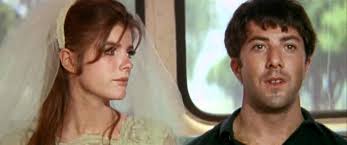
I was in High School when this movie was released, and not quite old enough to be allowed in to the cinema to watch it on my own. If I had seen it then, I wonder what effect it might have had on my developing adolescent personality. The music was great, but the plot and resolution of the movie were disturbing, to say the least, and must have seriously confused many an adolescent as they went through that difficult time of trying to establish an identity of their own.
How, I wonder, would I have reacted to that movie, as a teen? Watching it for the first time in my sixties was to see it through the eyes of someone who has personally experienced, as well as observed in others, the complications, both joyous and tragic, that love and lust can bring to life. I am sure the two viewpoints are vastly different - have you belatedly watched a movie that was part of the canon of your youthful times, and how did you find it, compared to the way it was received back then?
At the time it was promoted as both a drama and a comedy - now, at times, in modern eyes, it seems quite creepy, and I struggled to find any humour in it at all. Almost everyone in the movie is trying to impose their will on someone else. Hofman's character seemed very wooden by any modern standard of acting - was that meant to depict some internal emotional turmoil, or perhaps an attempt to show a character we would now describe as "On the Spectrum"?
His treatment of the ultimate target of his affections - Elaine, the daughter of his lover - can only be described as stalking, and the denoument at the wedding looks more like an abduction than a mutual flight into a romantic future. Although Elaine finally reacts against the demands of her parents and older relatives by fleeing the church in which she was about to marry the man her parents had chosen for her, their reactions to each other as the bus takes them away from the church left this viewer wondering if she was already beginning to wonder which future was the frying pan and which the fire.
I was in High School when this movie was released, and not quite old enough to be allowed in to the cinema to watch it on my own. If I had seen it then, I wonder what effect it might have had on my developing adolescent personality. The music was great, but the plot and resolution of the movie were disturbing, to say the least, and must have seriously confused many an adolescent as they went through that difficult time of trying to establish an identity of their own.
How, I wonder, would I have reacted to that movie, as a teen? Watching it for the first time in my sixties was to see it through the eyes of someone who has personally experienced, as well as observed in others, the complications, both joyous and tragic, that love and lust can bring to life. I am sure the two viewpoints are vastly different - have you belatedly watched a movie that was part of the canon of your youthful times, and how did you find it, compared to the way it was received back then?
Thursday, 22 June 2017
Skewed points of view
I have been contemplating how my age, social and cultural backgrounds, and life experience, affect not only my point of view as I write a story, but the points of view that I inflict on my characters.
There have been occasions in writing group that some of us have attempted to write from a different pov than our natural position - different gender, for example, is a common prompt. But there is also something I said to a friend some years ago about generation gaps. I have really grown up in a different world to someone who is twenty or forty years younger than me. When I am talking with someone of another generation, though we both say we are speaking English, the words have subtly changed their meanings from my time to theirs. New words and phrases have been coined, old words have been put to new purposes, and some words have fallen from use altogether.
To some extent, I can understand my parents, because I grew up listening to them, and my children have the same experience with me - but even another half a generation later, the flow of language has swept onwards, leaving me stranded on the mud-banks of time. Doctor Who does a remarkable job, all things considered, being able to talk to humans from so many periods of history (and pre-history, it seems)
The differences include the technology, but also significant cultural changes - my experience with the tension of the Cold War and its constant threat of nuclear war is different to the experiences of people born since 1970, but that may be changing as we speak, and another generation may be experiencing the subtle "valley of fear" effect that impacted the lives, decisions and thought processes of so many people who grew up in the fifties and sixties.
Likewise, my parents and grandparents had direct experience of the Great Depression, and one or more of the World Wars. My grandparents saw the great Flu Epidemic that slew so many of those who survived the First World War. I lived in a world where vaccination, refrigeration, mains electricity, treated water on tap, and push-button sewage disposal seemed to have always existed - they knew what it was to walk to the well, or the water tank behind the house, and they knew of the need to boil the water, and they saw the children die of diseases - polio and measles - that were to my generation just a distant rumour. The evidence of that passing world was still to be seen, in the maimed survivors of the recent World War who could be met on any suburban or city street, in the newsreels at the cinema that discussed the final defeat of polio, or the visits to the rural relatives who still lived on dusty or muddy farms, getting their water from well or tank, and lighting their houses with kerosene lamps.
Of course, the discrepancy in viewpoints is not just caused by temporal differences - geography can have a say. The charmed life that I and so many like me have taken for granted has never existed in many parts of the planet, including parts of Australia, and still does not exist in places where it should. It is possible that it never will. In the seventies, we dared to hope that a Golden Age was dawning for all the world - in 2017 we wonder if the world will survive, and some of us believe that we may already lived through the best of times. Is that why dystopian novels attract such a following?
Of course, many things don't fundamentally change, but simply adjust their clothes or hairstyles - bigotry, greed, anger, and fear still pervade society, and are still used by politicians seeking to gain power for themselves without having to present intelligent and positive policies.
Technological changes have effects beyond the obvious - someone like me, who has lived through many such changes (as well as launching into a Thoreau inspired "tree-change" for a couple of decades) is often stunned when a younger person reveals an assumption that certain services have "always been around" Try explaining black and white television to an eight year old in the nineteen eighties, or the previous absence of mobile phones to someone born after 2005. Technology that is now ubiquitous is considered to be something that "no one could live without"
For example, I recently heard an historian talking about the complaints made to the Council of the City of Sydney over the years. I had never heard before that, when gas powered street lamps were introduced to Sydney, a policy designed to save money meant that the lamps were not lit on the night of the full moon, nor on several nights either side of it. What seemed a logical cost saving measure to an accountant who may never have been out in the streets after dark was a serious nuisance - even a danger - to the many people who needed to travel the city streets after sunset.
Did that happen in other cities of the world as the first street lamps were introduced? If I were writing a novel set in that time, what other such quirks might affect my characters as they go about their business?? It is hard to realistically imagine a future world in a novel, but it can be quite tricky to write about the past if we take our 21st Century assumptions with us into the novel.
Subscribe to:
Posts (Atom)